
We build houses to last for generations. Ask people whether they expect their windows and doors to last as long, and most will tell you no. They expect to replace them at some point.
If you already expect to replace it, that replacement is part of what it costs. It just isn’t on the quote.
How long is “at some point”? Home inspectors’ published guidelines say a sliding patio door’s rollers and tracks typically need attention at around 20 years. A roller is usually a simple fix. A worn track, or parts that are no longer made, is where a repair turns into a replacement. So ask: will parts still be available in 20 years?
Now try this. Picture yourself 15 or 20 years from now, standing in front of the door you’re choosing today. If it has to be replaced, you’ll pay for a new door, removal, installation, trim and finishes, at tomorrow’s prices. Now divide what you paid today by the years it actually worked. That’s what it really cost you per year. Professionals have formal methods for this, called life-cycle costing, and they add energy and maintenance, but the idea is that simple.
How many years you get depends on things a quote doesn’t show: how well it keeps out air and water, how it was tested, how it was installed and how it’s maintained. That’s what this series has been about. Some NanaWall systems from my first projects, back in 2009, are still in use today.
If you’re renovating, there’s a cost that never shows on the door quote: the structure. Going from a 6 or 7 ft patio door to a 13 ft opening means a new, larger header, often designed by an engineer. And an operable system needs a header that barely moves. NanaWall asks for no more than L/720 of the span or ¼ inch, whichever is less, under full load. That’s stricter than the building code’s minimum. So plan it once, up front. “We’ll put in a patio door now and open it up later” rarely happens, because later means opening the wall again.
The other side is value, and that’s even harder to see on a budget line.
Here’s an example from two NanaWall drawings for the same opening, 13 ft 1 in wide by 7 ft 10 in high:
The NW MultiSlide 630, two panels: one vertical line when it’s closed. It opens about 6 ft, less than half the width.
The NW Aluminum 640 folding system, four panels: more vertical lines when closed. It opens about 10 ft 7 in, roughly 80% of the width, and its swing panel works as the everyday door.
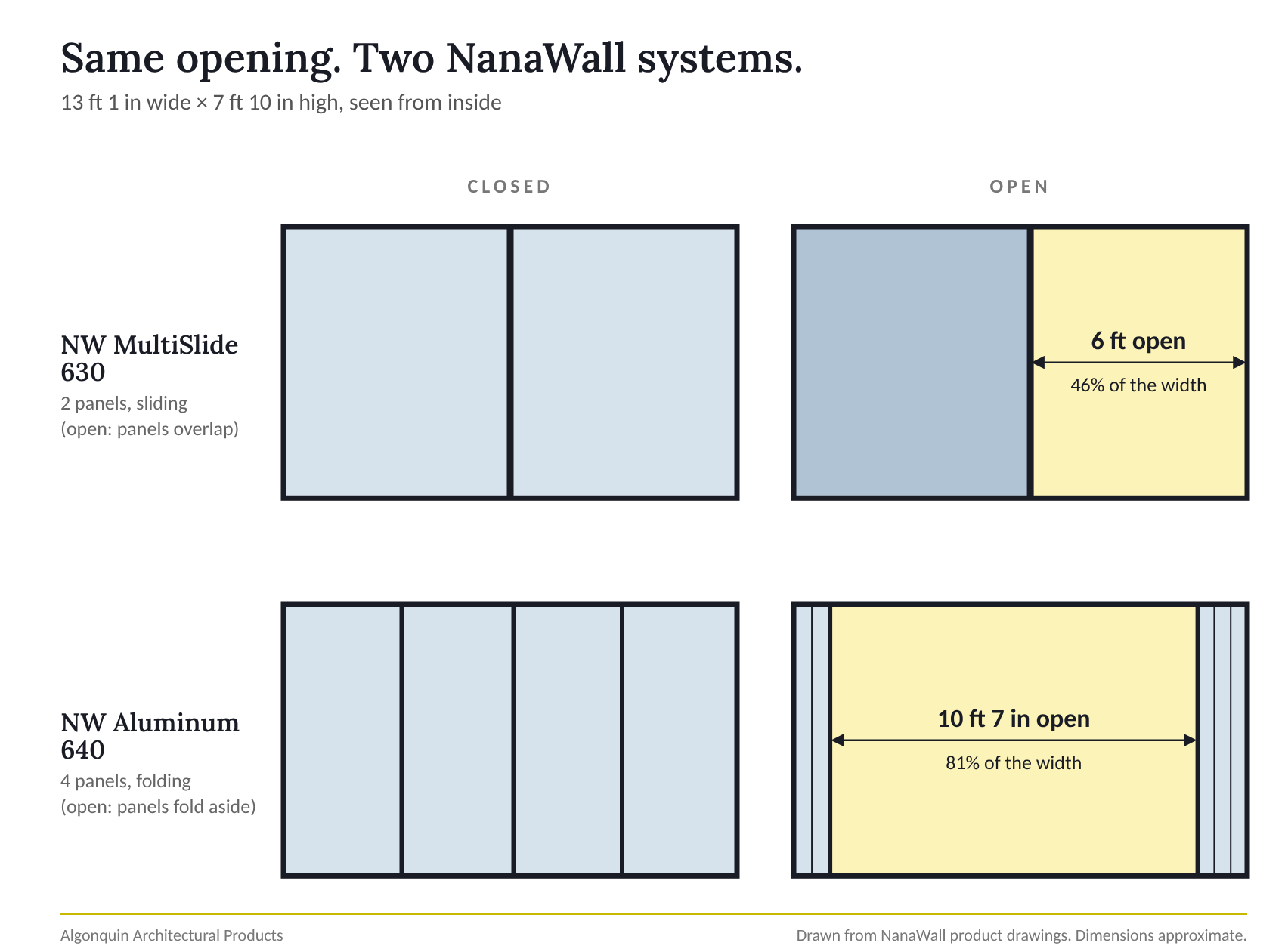
Same opening, two NanaWall systems: the NW MultiSlide 630 and the NW Aluminum 640, closed and open.
In my experience, these two are often priced close to each other. So the choice isn’t about money. It’s a cleaner look when closed, or a wall that opens up when you want it. Neither is wrong. But to choose, you have to picture yourself living there: the summer evening, the family gathering, the everyday.
Now the harder case. The system you really want costs more than the budget. Say you have 70% of what the folding system costs, enough for a standard sliding door. It’s easy to talk yourself into either one. Once we’ve decided, we can justify almost any purchase. A better question: which one will you still be glad you chose in 15 years? Sometimes the answer is to buy what you can afford today. Sometimes it’s to wait, save, and do it once.
I represent NanaWall, so I’m not neutral, and both systems above are NanaWall. I’d just like the decision to be made on what it will cost and what it will give you over the years you live with it, not on the price on day one.
For the architects and designers out there: when a client’s budget falls short of what they really want, do you tell them to build now or to wait?
If you’re weighing that decision on a project, call me at (416) 388-1445, email gelagasse@algonquinap.com, or come open one yourself at our Liberty Village showroom in Toronto.
— Georges Lagassé, President, Algonquin Architectural Products