
Everyone asks about thermal. Ask about air and water.
Ask an architect or a homeowner (or restaurant owner) how a window or an operable glass wall performs, and you'll almost always get the same answer: thermal. U-value. Energy. Fair enough. It matters, and in Ontario it matters a lot.
But in 16 years and more than 1,000 installed NanaWall projects across this province, I've learned that thermal is only part of the story. Once an operable glass wall is in, what people notice day to day is whether the floor beside it stays warm in January and dry after a storm. That's air and water. Those two numbers decide how a large operable glass wall system lives, and they're the ones almost nobody asks about.
Water first. A recent article in The Construction Specifier, by engineers at Simpson Gumpertz & Heger, looks at dynamic fan testing. A large fan drives air at a facade while water is sprayed across it, simulating wind-driven rain. It has mostly been a lab test on mock-ups, but smaller fans are bringing it onto real buildings, and a field version of the standard is in the works. The authors' view is simple: any water that leaves its designed drainage path is a failure. I agree.
It's also a good reminder to ask how a water rating was earned. The water ratings in the North American standard, including the NanaWall results below, come from static pressure tests: water is sprayed on the unit while a steady air pressure is held against it. That's the standard test, and a meaningful one, but it isn't a fan test. Compare like with like.
Now air. Water is about damage. Air is about comfort. A leaky frame means a cold floor and a chair nobody sits in. In our winters, it also means condensation and frost on the frame as warm indoor air finds its way out. An operable glass wall people avoid six months of the year isn't doing its job, however good it looks in July.
Here's the part I'd encourage every specifier to use. In Canada, operable products are tested to the North American Fenestration Standard (NAFS) plus the Canadian supplement, CSA A440S1, and you can ask for the results. The supplement gives an air infiltration/exfiltration level from A1 to A3, with A3 the tightest. Water is reported as the pressure the unit held with no uncontrolled leakage.
A real example: the NanaWall NW Aluminum 640 with its Performance Sill was tested by Intertek, an independent laboratory, on a four-panel unit about 13 ft wide by 8 ft 6 in high. It reached A3 for air, at 0.03 cubic feet per minute per square foot at the standard 75 Pa test pressure. It held with no uncontrolled water leakage at 9 psf (450 Pa).
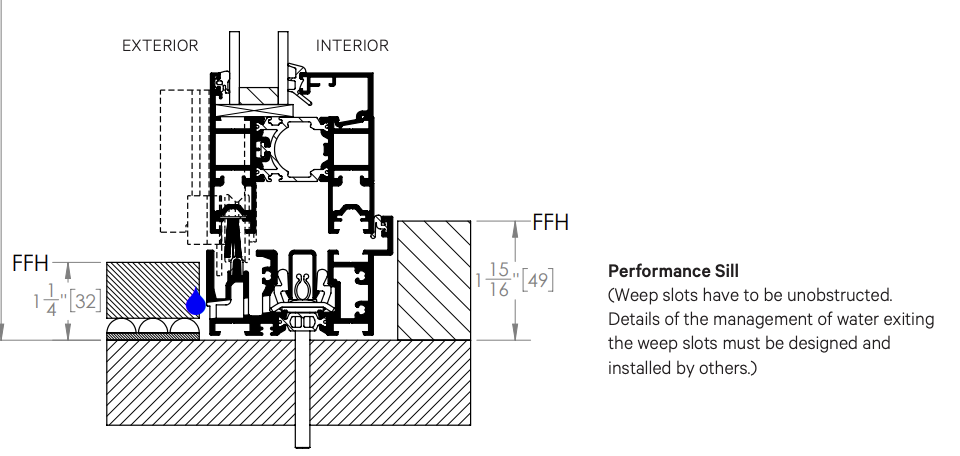
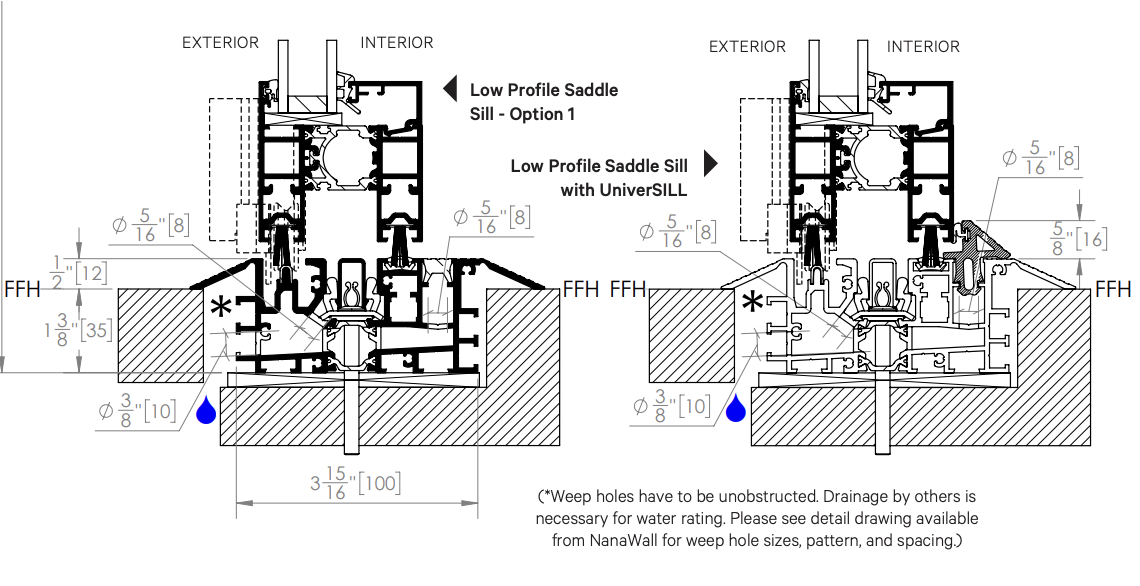
Two NW Aluminum 640 sill options, from NanaWall’s details: the Performance Sill (top) and the low-profile saddle sill, shown with and without the UniverSILL (bottom).
And here's the honest trade-off, the one I'd rather talk about up front: the threshold (the bottom track) is where the decision gets made. The low-profile saddle sill is lower and easier to step over. It tested at A2 for air, with no water leakage at 5.43 psf. On outswing units, adding NanaWall's UniverSILL brings that to 7.5 psf. Those are solid results, but different ones. Neither choice is wrong. It depends on exposure, overhangs and how the space will be used. What matters is that the choice is made on purpose, with the numbers on the table.
Two last things. Testing is done on one specific size and configuration, with a specific sill. Results for other configurations may be a little different, so ask what was tested and make sure the numbers you're shown match what you're buying. And a lab result is only as good as the installation that follows it. Installation is not a detail.
So the next time you're looking at an operable glass wall, ask about thermal, by all means. Then ask about air and water. A large operable glass wall only earns its place if it's tight enough to live beside in February and trusted enough to throw open in July.
I represent NanaWall, so I'm not neutral. I'd still rather you ask these questions of every supplier, including us.
For the architects and designers out there: has a client ever asked you about air and water, or only about thermal?
If you're weighing that decision on a project, call me at (416) 388-1445, email gelagasse@algonquinap.com, or come open one yourself at our Liberty Village showroom in Toronto.
— Georges Lagassé, President, Algonquin Architectural Products